First Client: AI Receptionist Onboarding | AIMERICA
One week ago, AIMERICA officially went live. This week, we signed our first client.
I want to use this episode to talk about what happens after a business says yes to an AI receptionist — because in this industry, the signature is the easy part. The hard part, the part that decides whether this company becomes what I believe it can become, is what happens in the days after: onboarding, implementation, and getting that AI receptionist actually answering calls for a real business. That's the machine we spent this week building, and in the spirit of this series, I'm going to show you the work while it's still on the bench.
If you're new here: this is The Journey of AIMERICA, a weekly, radically transparent chronicle of building an AI front office company — Front Office as a Service — from zero toward a nine-figure business. Episode 1 covered launch day. This is what week one actually looked like.
From Launch Day to First Client
I won't name the client — they didn't sign up to be content — but I will tell you what the moment felt like, because it's different from every other deal I've closed in my career, and I've closed a lot of them.
When you sell for an established carrier, the product existed before you and will exist after you. The client is buying a known quantity. When your brand-new company signs its first client, they're not just buying the product — they're trusting the company. They're betting that the thing you launched seven days ago will answer their phones, book their appointments, and represent their business to their customers.
That trust is a debt. And the way you pay it back is implementation.
The Two-Week Standard: How We Onboard an AI Receptionist
Here's the commitment we're engineering toward, and I'm publishing it so you can hold us to it: a new client fully implemented and running in two weeks, maximum.
This week, that meant two parallel builds. My co-founder Charles is building the client implementation workflow directly into the AIMERICA platform — so that when a new client is uploaded into the system, the process that follows isn't tribal knowledge in someone's head, it's a defined sequence the system itself drives. And on my side, I'm building the client-facing half of that sequence, starting with something as unglamorous as it is important: the welcome email. The first thing a new client receives from us sets the tone for the entire relationship — what happens next, who they'll hear from, what we need from them, and when they'll be live.
Why does onboarding deserve this much obsession? Because an AI receptionist isn't a gadget you unbox. Done right, implementation is where the AI stops being generic and becomes their front office: how their calls should be greeted, where calls route, what the business actually does, what gets booked and what gets escalated to a human. Every hour of setup quality shows up later in thousands of answered calls.
And here's the industry education piece: most businesses that try AI phone tools get burned not by the AI, but by the implementation. The patchwork, custom-build approach — stitching together a phone system, an AI bot, a scheduler, and a billing platform from four vendors — means onboarding is a months-long consulting project with an invoice to match. Our entire thesis at AIMERICA is one brain, one bill: because the whole front office lives on one platform, implementation can be a repeatable, two-week process instead of a bespoke science project. Standardizing onboarding is how a category gets built.
The Details Nobody Sees: Redrawing a Logo for a Telephone
One more piece of transparency from this week, because it's the kind of thing nobody tells you about building a hardware-backed company.
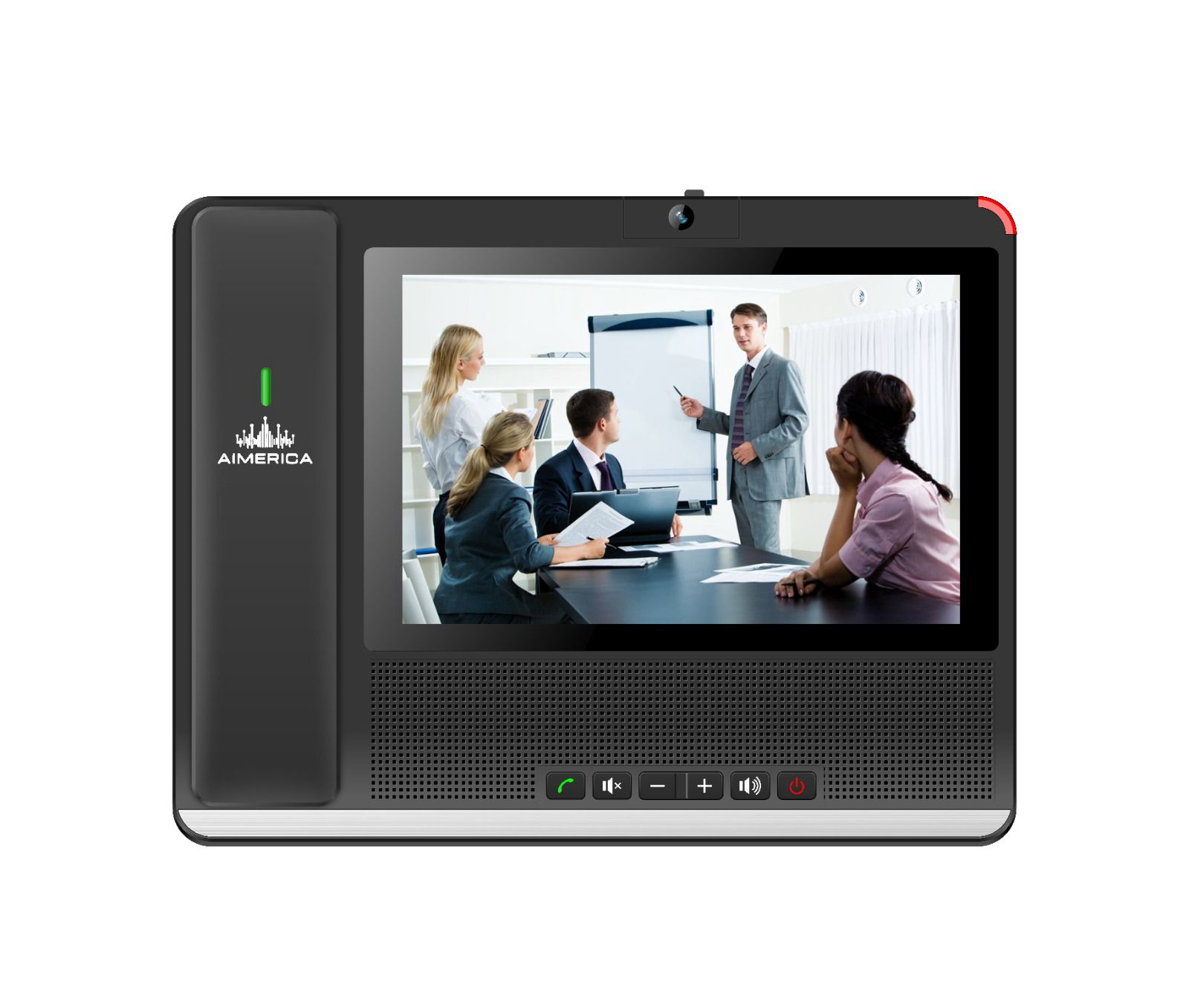
Our desk phones are in production under the AIMERICA brand, and this week we worked on the logo print for the physical handsets. Here's the problem: the AIMERICA mark — our flag crown — has 29 bars in it. At full size, on a website or a banner, it's beautiful. Silk-screened onto a telephone, the bars sit too close together to print cleanly. So the mark had to be completely redrawn for print at phone scale: same silhouette, every bar preserved, stems thinned, geometry mirrored to be truly symmetrical. We also set the rule for where branding lives on the device — wordmark alone on the handset, full mark and wordmark on the rear housing.
Is that glamorous? No. Is it the difference between a product that looks like a real American brand and a product that looks like a sticker on someone else's phone? Absolutely. When you build an AI front office company that ships its own hardware, you end up sweating details like minimum line widths on a silk screen. I'm sharing it because this series exists to show the real work — and the real work is mostly this.
Why the First Client Matters If You Sell — or Want To
Every week I write about the sales career we're building alongside the company, because creating a new segment of VoIP sellers — a recognized career path the way insurance, fiber, and solar sales are — is as much the mission as the product is.
Here's why this week matters to that mission: the first client is proof the category closes. Insurance didn't become a career until policies sold. Solar didn't become a career until panels went on roofs. An AI receptionist is now something a business in our market has bought, from a company one week old, because the problem it solves — missed calls, lost bookings, five vendors and five bills — is that real. The sellers who build careers in a category are the ones who show up while the proof is still being made, not after it's obvious.
And the two-week onboarding standard is a seller's feature as much as a client's. In the segments where sales careers thrive, reps can promise a clean, fast, predictable install — and the company keeps that promise. That's what we're building here. If you're a salesperson watching this space and wondering whether to learn it: episodes like this one are exactly the education you'd need on day one. PM me.
What's Next
Next week: more on the implementation build as it hardens from a plan into a system. The client is in. The clock is running. That's the journey.
— Sean
AIMERICA — AMERICAN SUPER INTELLIGENCE. One brain. One bill. Follow the journey every Monday at aimerica.si.
FAQ
How long does it take to set up an AI receptionist? It depends on the provider. Patchwork solutions assembled from multiple vendors can take months to implement. At AIMERICA, because the phone system, AI receptionist, scheduling, and billing live on one platform, we're building our onboarding to a two-week maximum standard — from signed agreement to fully live.
What happens after a business signs up for an AI receptionist? Implementation: the business is set up on the platform, call greeting and routing are configured, the AI is trained on what the business does and what it should book versus escalate, and the client is walked through everything before going live. The quality of this stage determines the quality of every call the AI answers afterward.
Is selling AI receptionists a real sales career? It's becoming one. Like insurance, fiber, and solar before it, the AI front office space is turning into a defined sales segment — recurring demand, a repeatable pitch, and products businesses understand. AIMERICA is building a certified reseller path for exactly this reason.